


What taxes are applied on donations from parents to children?
Table of Contents (20)
- What taxes are paid on a donation from parents to children?
- Taxes on donations from parents to children in Catalonia and other places
- Who pays the gift tax?
- Where should this tax be paid?
- What is the deadline for paying the gift tax?
- How are money donations from parents to children taxed? And what about donations of property or other assets?
- What tax reductions or benefits can there be in donations from parents to children?
- The IRPF applied after a donation from parents to children
- Who is obliged to pay the tax?
- Why must one pay Personal Income Tax (IRPF)?
- How is it calculated?
- The transmission cost
- The municipal Plusvalía is also taken into account in a donation
- What is municipal capital gains tax and when must it be paid?
- Who should pay for it?
- What is the deadline for paying it?
- How is it calculated?
- Where is it paid?
- Other questions
- Contact JLA Notarios for more information on how donation taxes are levied.
In the previous post, we have seen the most frequently asked questions about donations from parents to children, but one of the most thorny issues is the tax matter. This issue raises certain doubts and is, from our experience, the turning point for whether or not to make a donation to a child. Therefore, in this article we want to give a brief overview of the taxes that must be paid if it is decided to make a donation in favour of a child, focusing on Catalan taxation.
What taxes are paid on a donation from parents to children?
Any donation from parents to children involves a transfer of assets from the parent to their child, with both acts being subject to taxation. There are two main taxes to consider when making a donation; the donation tax and the income tax (IRPF).
Additionally, we must highlight another tax related to the donation of real estate, something quite common between parents and children, the municipal capital gains tax.
Let us now examine each of them separately.
Taxes on donations from parents to children in Catalonia and other places
The gift tax is a state tax regulated in Law 29/1987, of 18 December on Inheritance and Gift Tax, whose management is delegated to the Autonomous Communities, which may set reductions, discounts or the tax rate, which can lead to significant variations between regions. In the case of Cataluña, it is included in the Legislative Decree 1/2024, of 12 March, which approves the sixth book of the Tax Code of Cataluña.
Who pays the gift tax?
In this case, it is the son who receives the goods, rights or donated amounts.
Where should this tax be paid?
The Autonomous Community that corresponds according to the following criteria will have jurisdiction for the settlement:
- If it concerns movable goods or money, the one where the child had their habitual residence.
- If immovable property (houses, land or premises) is donated, the one where the property is located will have jurisdiction.
What is the deadline for paying the gift tax?
The general rule is thirty working days, counting from the day after the act or contract takes place. The deadline to settle the donation tax in Catalonia is one month counted from the day the act or contract takes place.
Both deadlines seem similar, but their difference is quite significant. In the thirty-day period, these are understood to be working days, excluding Saturdays, Sundays, and declared holidays from the count. On the other hand, in deadlines specified by months, they are counted from date to date. If in the month of expiry there is no day equivalent to the initial date of the count, the deadline is understood to expire on the last day of the month. When the last day of the deadline is a Saturday, Sunday, or holiday, it is extended to the next working day.
How are money donations from parents to children taxed? And what about donations of property or other assets?
As we have mentioned, although it is a state tax, it is delegated to the Autonomous Communities, and they are the ones who set certain aspects such as reductions, applicable rates, discounts, coefficients, etc. For this reason, it can vary considerably from one Community to another, so we will focus on the donation tax in Catalonia, calculated according to the following rules:
- Taxable base: In Catalonia, as in the other Autonomous Communities, it must start from the taxable base, that is, the value of the donated item. If a property or money worth €100,000 is donated, this amount will be the starting point.
- Net taxable base: In donations, the net taxable base corresponds to the taxable base, except when any of the reductions that we will see below apply.
- Gross amount: It is obtained by applying the reduced tax rate to the net taxable base, which corresponds to groups I and II and when the donation is made before a Notary, the said rate being as follows:

- Group I: is made up of descendants and adopted children under twenty-one years of age
- Group II: is composed of descendants and adopted children aged twenty-one or over, spouses, ascendants and adoptive parents.
- Tax Quota: this calculation is the final step in quantifying the tax and is equivalent to the amount to be paid. This amount is obtained by applying the corresponding multiplier coefficient to the full quota, which depends on the assets that the child had prior to the donation. This coefficient is as follows:
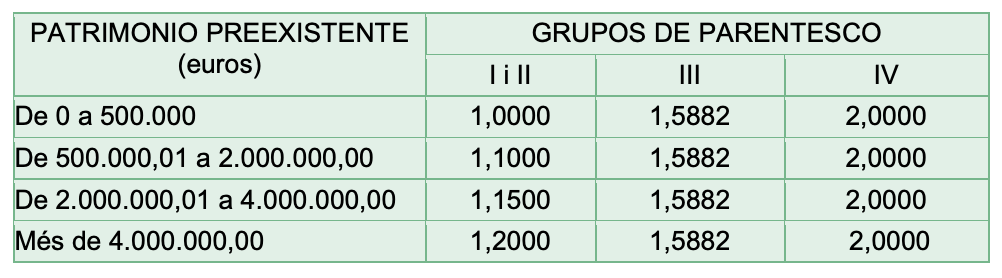
The amount resulting from this entire operation will be the one that must be paid to the tax authorities through form 651.
What tax reductions or benefits can there be in donations from parents to children?
I.- Donation of a house or land, or money to acquire these, provided that it will constitute their main residence.
- The donee must be a child or descendant of the donor and not be older than 36 years, with a taxable base in the IRPF of less than 36,000 euros.
- The reduction will be 95% of the donated amount up to a maximum of €60,000, which can reach €120,000 for children who have a degree of disability equal to or greater than 65%.
- In the case of money donations, the child must acquire the property within three months from the date of the donation.
- In the case of land, it is necessary that the first habitual residence of the child is built on it, and that this construction is carried out within three years following the date of the donation.
II.- Donation of money to establish or acquire a professional business or a company or to acquire shares in entities.
- The donee must be a child or descendant of the donor, be no older than 40 years, and their assets cannot exceed €300,000.
- The reduction will be 95% of the donated amount, up to a maximum of €200,000, which may reach €400,000 in the case of disabled persons with a degree equal to or greater than 33%.
- The company, business or entity must have its registered and tax address in Catalonia and the net turnover of the last financial year must not exceed €3,000,000 if it is a company or €1,000,000 if it is a professional business.
- The child must continue to perform management functions in the entity for the five years following the donation.
III.- Donation of cultural heritage assets.
- The donee must be a child, descendant or also the spouse of the donor.
- The reduction will be 95% of the value of cultural assets of national interest and of the catalogued movable goods.
- That they are kept in the child's estate for at least 5 years.
IV.- Contribution of assets to a protected estate.
- It is not mandatory for the donee to be a child or descendant of the contributor, but they must meet the disability requirements established by the Law. You can learn more here about the notary service for the constitution and contributions of protected assets.
- It implies a 90% reduction of the donated amount.
The IRPF applied after a donation from parents to children
The majority of people who intend to make a donation to a child believe that they only have to pay tax on the donation tax, but they are unaware that they must also do so for income tax. This is the great unknown in donations.
Who is obliged to pay the tax?
The father, who is the one making the donation. He must do so in the income tax return corresponding to the year in which the donation was made.
Why must one pay Personal Income Tax (IRPF)?
The father must pay tax on the capital "gain" he has had, that is to say on the increase in value between the acquisition price and the transfer price. How can this be if it has been transferred free of charge and there is no gain? Well, although it may seem incredible, it is so, because the donated asset has a value at the time of making the donation, and if this is higher than the acquisition value, tax must be paid.
How is it calculated?
Capital gain is calculated by the difference between the acquisition value and the transfer value (donation).
The acquisition cost paid will be, according to the Tax Agency itself:
- In the case of properties acquired for consideration: the purchase price including expenses and taxes inherent to the acquisition (notary, registry, non-deductible VAT, Transfer Tax and Stamp Duty, agency fees, etc.) as well as the cost of investments and certain improvements made.
- In the case of properties acquired gratuitously (inheritance or donation): the value of the asset determined according to the rules of the Inheritance and Donations Tax without exceeding the market value, together with the expenses and taxes paid for its acquisition as well as the cost of investments and improvements made.
The transmission cost
It will be the value stated in the deed, which cannot be lower than the reference value set by the Treasury, unless a lower value is justified through an appraisal. This value may be reduced by deducting the necessary expenses paid by the donating father.
However, this applies to the donation of assets, mainly real estate, since if money is donated there is no such increase in wealth, because the nominal value of the money does not change.
The municipal Plusvalía is also taken into account in a donation
What is municipal capital gains tax and when must it be paid?
The municipal capital gains tax is the common name for the Tax on the Increase in Value of Urban Land. This is a municipal tax that levies the increase in value of urban land.
This tax must be paid when the donated asset is an urban property, such as a house, land, a garage, or a commercial premises, for example.
If what is donated is rural land, this tax will not have to be paid, nor will it be paid if the assets are movable property or money.
Who should pay for it?
The municipal capital gains tax is paid, as it is a lucrative transfer, by the person receiving the asset, that is to say, in this case, the son, according to article 106.1a of the revised text of the Law Regulating Local Authorities.
What is the deadline for paying it?
The deadline to submit the settlement is 30 working days from the granting of the lifetime donation from parents to children, with no possibility of extension.
How is it calculated?
Regarding the calculation of the capital gains tax, at JLA Notarios, we wrote a specific post on our blog discussing the topic, including the latest updates. We leave you the link here in case you are interested.
The new municipal capital gains tax. A brief guide to the new Royal Decree and the main updates
Where is it paid?
The capital gains tax must be paid at the town hall of the locality where the person managing the procedure is located.
Other questions
Many of you ask us questions which we will answer below:
It is important to know that the law does not establish a limit from which donations must be declared. However, it is true that there is a myth about a certain amount, set from €3,000, at which financial institutions must report to the Tax Agency if movements are made in the account. Nevertheless, any gift that one person gives to another, no matter how small, is considered a donation by law.
The model 651 is used to settle the gift tax.
The price charged by a Notary for a deed of donation is regulated in the notarial tariff and depends on the value of the donated assets, the geographical location, the complexity of the deed. It is important to know that notarial costs are set by law and that all notaries must charge the same for their services. To obtain an accurate estimate, it is advisable to consult directly with your trusted notary.
Contact JLA Notarios for more information on how donation taxes are levied.
I hope I have been able to clarify some doubts about the taxes applied in the case of donations from parents to children. Often, the taxes to be paid and how donations of money from parents to children are taxed are unknown, which can cause surprises… Therefore, it is very important that you seek proper advice if you are going to make a donation to your child or are going to receive a donation from your parents.
If you need any advice or assistance, do not hesitate to contact J&LA Notarios Asociados in Barcelona, as each client and situation is different and everything must be tailored to their specific case. We are Notaries in donations in Barcelona, fully available to assist you.


